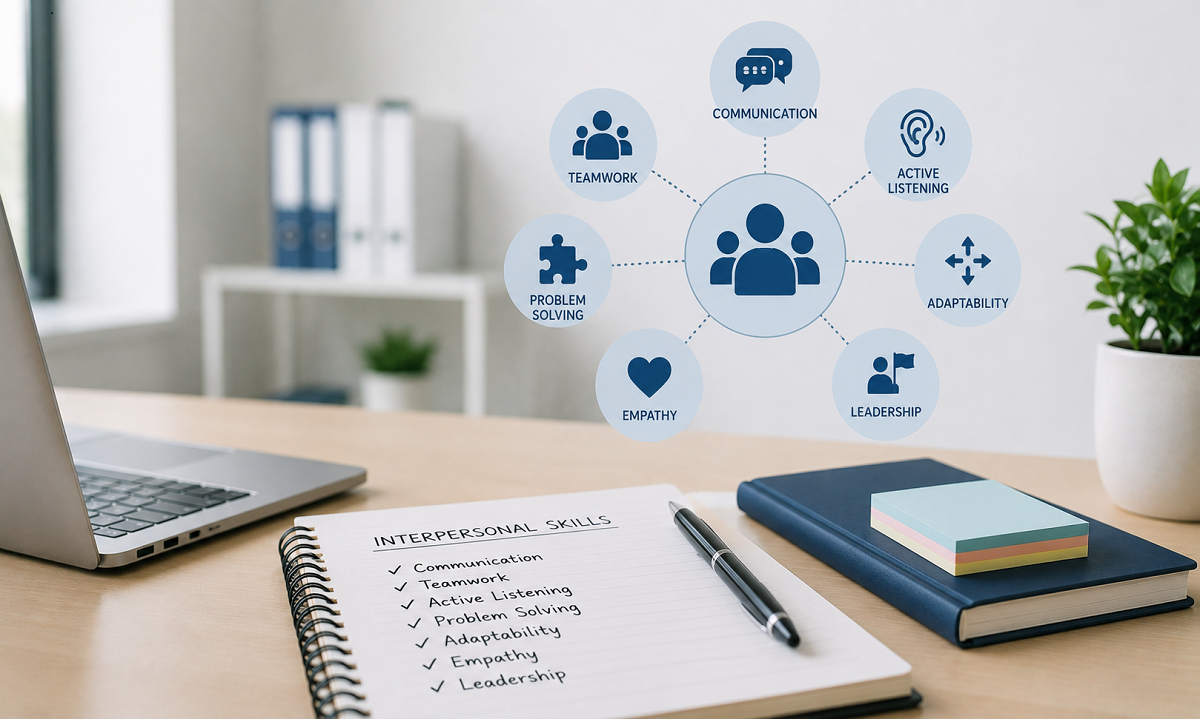
You know you are good with people. You build relationships easily, communicate clearly, resolve conflicts calmly, and bring out the best in the teams you work with. But when you sit down to write your resume, those qualities somehow disappear into vague, you’re not sure which of the interpersonal skills to put on your resume, forgettable phrases like “good communicator” and “team player” that appear on every other candidate’s resume and impress exactly no one.
The problem is not that your interpersonal skills are weak. The problem is that most professionals do not know how to describe them specifically enough to be credible or memorably enough to stand out. This post fixes that completely. We give you specific, ready-to-use examples of interpersonal skills for every industry and experience level, explained in a way that makes them genuinely convincing to recruiters and hiring managers who read your resume.
Why Interpersonal Skills Matter More Than Ever on a Resume

The world of work has become more collaborative, more cross-functional, and more relationship-dependent than at any previous point in professional history. Remote teams, matrix organizations, client-facing roles, and project-based work structures all require professionals who can communicate effectively, navigate conflict constructively, and build trust quickly across diverse groups.
According to LinkedIn’s Global Talent Trends Report, communication, collaboration, and emotional intelligence consistently rank among the most sought-after professional qualities by hiring managers across every industry. The challenge for job seekers is that everyone claims these qualities. The candidates who get interviews are the ones who can demonstrate them specifically.
A well-written interpersonal skills section for the resume does three things simultaneously. It signals professional self-awareness by showing that you understand which people skills are most relevant to the role. It builds credibility by describing the skill in a specific, contextualized way rather than as a bare claim. And it differentiates you from the dozens of other candidates who listed the same skill with zero supporting evidence.
For more career resources that help Nigerian professionals build stronger applications and find better opportunities, visit thecareerbloghub where we publish practical career guidance every week.
Make Your CV Stand Out
If your CV isn’t clearly showcasing your technical projects, academic achievements, SIWES readiness, leadership experience, and engineering or technology skills, you may be missing opportunities. A professionally structured CV can help present your value more effectively. Need yours refined? Contact us via WhatsApp: +2348145289661.
The Most Valuable Interpersonal Skills to put on Your Resume
1. Communication Skills for Resume
Communication is the most universally requested soft skill for a resume across every industry and seniority level. But listing “communication skills” without context tells the recruiter nothing useful. The skill is too broad and too commonly claimed to carry any weight on its own.
The more effective approach is to specify the type and context of communication you excel at. Here are examples that move from weak to strong:
Weak: “Good communication skills.”
Strong: “Communicated complex financial data to non-finance business leaders through monthly dashboard presentations, enabling faster and more confident budget decisions across four business units.”
Stronger: “Developed and delivered a three-session training programme on customer complaint handling for 45 frontline staff, resulting in a 28 percent reduction in escalated complaints over the following quarter.”
The second and third examples are not just claiming communication skill. They are demonstrating it through a specific professional context with a measurable outcome. That is the standard your communication skills for resume descriptions should aim for.
Communication subcategories worth specifying separately where genuinely relevant include executive-level presentation and stakeholder communication, technical writing and documentation, cross-cultural communication for international or diverse teams, persuasive proposal and business case writing, and facilitation and workshop delivery.
2. Active Listening
Active listening is one of the most underrated key interpersonal skills in professional environments and one of the most genuinely differentiating when described well on a resume. Most people hear. Far fewer people truly listen in a way that makes others feel understood and generates better outcomes.
In practice, strong active listening shows up in how you conduct client needs assessments before proposing solutions, how you facilitate team meetings where quieter voices still get heard, how you handle employee grievances in HR, how you manage patient consultations in healthcare, and how you negotiate with vendors or clients who have complex needs.
A strong resume description might read: “Conducted structured listening sessions with twelve department heads to identify operational bottlenecks before proposing a process redesign, ensuring the solution addressed root causes rather than symptoms.”
That single sentence communicates active listening, strategic thinking, and collaborative problem-solving in a way that a list of soft skills never could.
3. Emotional Intelligence
Emotional intelligence or EQ describes the ability to recognize, understand, and manage both your own emotions and the emotions of the people around you. It is the quality that determines how effectively you lead teams, manage conflict, navigate organizational politics, and maintain professional performance under pressure.
For HR professionals listing this skill, it might appear as: “Managed a sensitive organizational restructuring that affected 60 employees by communicating transparently, providing individual transition support, and maintaining team morale through a six-month change process.”
For sales professionals, it might look like: “Applied empathetic listening and emotional cue recognition to customize product presentations for different client stakeholder personalities, closing 14 of 18 enterprise accounts in the financial year.”
Emotional intelligence is most convincingly demonstrated through specific situations where you navigated human complexity successfully and produced a measurable professional outcome as a result.
For HR professionals who are actively looking for roles where strong interpersonal skills are explicitly valued, our recent article on Human Resources Jobs in Nigeria covers verified current vacancies at top Nigerian employers across banking, FMCG, technology, and NGOs.
4. Conflict Resolution and Negotiation
The ability to address and resolve interpersonal or professional conflicts constructively is one of the interpersonal abilities that hiring managers at every level specifically look for and rarely find described well on resumes. Most candidates either omit this skill entirely or mention it so vaguely that it adds no value.
Conflict resolution on a resume should be specific about the type of conflict you navigated, the approach you took, and the outcome you achieved. Here are two examples:
“Mediated a six-month vendor dispute involving a 200 million naira contract disagreement by facilitating structured negotiations between procurement and legal teams, reaching a mutually acceptable resolution that preserved the business relationship and avoided litigation.”
“Resolved a cross-departmental conflict between the marketing and product teams over campaign launch timelines by establishing a joint working session, clarifying competing priorities, and creating a shared delivery schedule that satisfied both departments.”
Both examples describe a real professional situation where conflict resolution skill was applied and produced a specific positive outcome. That is the standard.
5. Collaboration and Teamwork
Teamwork is perhaps the most overused phrase on Nigerian resumes and simultaneously one of the most genuinely important qualities employers look for. The reason it fails to impress when listed generically is exactly the reason it becomes powerful when described specifically.
The best people skills for resume descriptions around teamwork name the team size, the cross-functional nature of the collaboration, the specific contribution you made, and the outcome the team achieved. For example:
“Led a cross-functional product launch team of nine members spanning marketing, engineering, legal, and customer success departments, coordinating weekly alignment sessions that resulted in the on-time launch of a payment feature serving 80,000 users in the first month.”
That description communicates leadership, coordination, cross-functional collaboration, and commercial outcome in two sentences. It is the kind of resume language that makes a hiring manager think this candidate knows how to work with people and get things done.
6. Leadership and Influence Without Authority
One of the most in-demand interpersonal communication skills in modern organizations is the ability to lead and influence people who do not report to you, a quality sometimes called lateral leadership or influence without authority. Matrix organizations, project teams, and cross-functional initiatives all depend heavily on professionals who can motivate, align, and direct colleagues who have no obligation to follow their lead.
Describing this skill effectively requires specifying the context of lateral influence, the approach you used, and the outcome it produced. A strong example: “Coordinated a compliance implementation initiative across six business units with no direct reporting authority by building relationships with divisional leads, communicating the business rationale clearly, and creating accountability through a shared tracking dashboard, achieving 100 percent implementation within the agreed timeline.”
That kind of description signals precisely the leadership maturity that senior hiring managers are looking for in candidates being considered for promotion or significant responsibilities.
7. Adaptability and Resilience
Adaptability describes the ability to adjust effectively to new information, changing priorities, unfamiliar environments, or unexpected challenges. Resilience describes the ability to maintain professional performance and composure under sustained pressure or after setbacks. Both are increasingly valued by Nigerian employers across every sector.
The most convincing resume descriptions around adaptability and resilience are ones that specify the nature of the challenge and the professional response. For example: “Transitioned a team of 12 to fully remote operations within 72 hours of a sudden office closure, maintaining 95 percent productivity levels and zero project deadline misses through rapid communication, new workflow design, and daily check-in rhythms.”
That sentence communicates adaptability, leadership, communication, and operational competence simultaneously. A single sentence that demonstrates interpersonal skill through a specific professional situation is always more powerful than a list of claimed attributes.
For professionals who want to understand how their interpersonal skills translate into salary negotiating power, our article on Desired Compensation Answer gives you the exact framework to discuss your value confidently in any salary conversation.
Interpersonal Skills by Industry: What Employers Actually Want
Understanding which interpersonal skills are most valued in specific industries helps you prioritize what to feature most prominently on your resume.
- In banking and financial services, client relationship management, persuasive communication, and professional discretion are the interpersonal skills that appear most consistently in job descriptions. The ability to communicate complex financial products simply and build trust with high-value clients is genuinely differentiating in competitive financial services hiring.
- In healthcare, empathy and patient communication are non-negotiable clinical interpersonal skills. The ability to deliver difficult medical information with compassion, manage anxious patients and families, and collaborate effectively with multidisciplinary clinical teams are all explicitly assessed in healthcare hiring processes.
- In technology and fintech, the interpersonal skills employers consistently prioritize are cross-functional collaboration, clear technical communication with non-technical stakeholders, and the ability to give and receive feedback constructively in fast-moving product development environments.
- In NGO and development work, community engagement, cultural sensitivity, and stakeholder facilitation are the most valued interpersonal competencies. The ability to build trust with community leaders, government officials, and international donors simultaneously is the hallmark of the most effective development sector professionals.
- In HR, emotional intelligence, conflict resolution, and the ability to influence without authority are the defining interpersonal competencies. HR professionals who can navigate difficult conversations, manage organizational change with care, and build credibility with skeptical business leaders consistently outperform their peers who have the same technical knowledge but weaker interpersonal capabilities.
For professionals building a complete picture of the skills employers are looking for across all categories, our guide on Skills to Put on a Resume covers both hard and soft skills with industry-specific examples that complement the interpersonal skills covered in this post.
How to Present Interpersonal Skills on Your Resume Without Sounding Generic
The three-part formula that consistently works is situation, approach, and outcome. Describe the professional situation where the skill was applied, explain the specific approach or behavior you demonstrated, and quantify the outcome where possible.
1. Avoid adjective-heavy descriptions like “highly empathetic communicator with exceptional interpersonal abilities.” These sound like self-promotion without evidence. Instead, let the specific situation and outcome demonstrate the quality implicitly. When the reader finishes your description, they should think that person clearly has strong conflict resolution skills, not that person says they have strong conflict resolution skills.
2. Every interpersonal skill you list in your skills section should be backed by at least one specific example in your work history section. The skills section announces the capability. The work history proves it.
For professionals who want to see how interpersonal skills integrate into complete professional summaries, our article on Resume Summary Ideas shows exactly how to weave specific soft skills into compelling professional summaries across every industry.
Making Your Interpersonal Skills Visible on LinkedIn
Your LinkedIn profile is as important as your resume for communicating interpersonal skills to hiring managers and recruiters. The About section of your LinkedIn profile is where you have the most space to describe your professional approach, including how you work with people, what kind of collaborator you are, and what colleagues and clients consistently say about working with you.
LinkedIn recommendations from colleagues, managers, and clients are the most powerful way to demonstrate interpersonal skills externally. A recommendation that says this person resolved our most difficult client relationship with professionalism and creativity is worth more than ten self-assessed soft skill claims. Actively request recommendations that speak to your interpersonal strengths specifically.
Our guide on How to Put Your LinkedIn on Your Resume walks you through how to connect your LinkedIn profile to your application materials so that the interpersonal qualities you demonstrate on LinkedIn reinforce the claims you make on your resume.
Make Your CV Stand Out
If your CV isn’t clearly showcasing your technical projects, academic achievements, SIWES readiness, leadership experience, and engineering or technology skills, you may be missing opportunities. A professionally structured CV can help present your value more effectively. Need yours refined? Contact us via WhatsApp: +2348145289661.
FAQs: Interpersonal Skills for Resume
What are the most important interpersonal skills to put on a resume?
The most universally valued interpersonal skills across Nigerian and international job markets in 2025 are communication, emotional intelligence, active listening, conflict resolution, collaboration, adaptability, and leadership or influence. The specific skills you prioritize should depend on the role you are applying for. Client-facing roles demand strong communication and relationship building. Leadership roles demand emotional intelligence and influence. Team-based roles demand collaboration and conflict resolution.
How do I describe interpersonal skills on a resume without sounding generic?
The key is specificity. Instead of listing communication skills, describe a specific instance where your communication produced a measurable outcome. Instead of claiming teamwork, describe a specific cross-functional project you contributed to and what the team achieved. Use the situation, approach, outcome framework to transform vague claims into specific evidence. Every interpersonal skill should be backed by a real professional example somewhere on your resume.
Can interpersonal skills really make a difference in getting hired?
Yes, significantly. A Harvard University study found that 85 percent of job success comes from well-developed soft and interpersonal skills. Technical skills get you in the room. Interpersonal skills determine whether you get the offer, whether you perform in the role, and whether you advance over time. In competitive hiring situations where multiple candidates have similar technical qualifications, interpersonal skills are frequently the deciding factor.
Conclusion: Build Your Interpersonal Skills Section and Get More Interviews
The interpersonal skills for resume examples in this post span communication, active listening, emotional intelligence, conflict resolution, collaboration, leadership, and adaptability across banking, healthcare, technology, NGO, and HR sectors. Every example follows the same principle: describe the skill through a specific professional situation with a measurable outcome rather than claiming the skill as a bare attribute.
Take the examples closest to your own professional experience, adapt the specific details to reflect your actual work history, and build a resume that demonstrates genuine interpersonal competency rather than just asserting it.
Best interpersonal skills to put on a resume for fresh graduates in Nigeria and people skills for resume in banking and HR roles are searches that professionals like you are making right now. The answers are in this post, and the next step is yours.
For professionals preparing for interviews where interpersonal skills will be directly assessed, our article on Why Do You Want to Work for Us gives you the exact framework for the interview question that requires every interpersonal skill covered in this post to answer well.
For professionals who also want to explore remote work opportunities where strong interpersonal communication skills are explicitly required, our Work From Home Jobs page covers current remote roles available to Nigerian professionals where excellent written communication and remote collaboration skills are the primary hiring criteria.
Keep visiting thecareerbloghub for more practical career guides, resume tips, and verified job listings that help Nigerian professionals present their very best professional self and land the opportunities that match their skills and career ambitions.