
The salary question makes most job seekers nervous and understandably so. You want the job badly enough to have made it to the interview stage. You do not want to say a number that is too high and lose the offer. But you also do not want to undersell yourself and spend the next two years earning less than you deserve. It is one of the most high-stakes moments in any job search and most people handle it badly by either giving a number without research or deflecting the question entirely.
The good news is that the desired compensation answer is a learnable skill. This post gives you the exact framework, real sample answers, and the research process that lets you name your number with confidence, back it up with logic, and protect both your chances of getting the offer and your earning potential for years to come.
Why the Desired Compensation Answer to Its Question Exists
Make Your CV Stand Out
If your CV isn’t clearly showcasing your technical projects, academic achievements, SIWES readiness, leadership experience, and engineering or technology skills, you may be missing opportunities. A professionally structured CV can help present your value more effectively. Need yours refined? Contact us via WhatsApp: +2348145289661.
Before you can answer this question well, it helps to understand why employers ask it in the first place. They are not trying to trick you. They are trying to do two things simultaneously.
First, they want to know whether you fit within their budget. Every role has an approved salary range and they need to confirm early in the process that your expectations are in the same general territory. Second, they want to see how you value yourself professionally. A candidate who confidently states a well-researched salary range communicates self-awareness and market knowledge. A candidate who panics or gives a random number communicates neither.
Understanding this changes how you approach the question. You are not at a disadvantage when this question comes up. You are in a negotiation where information is power and preparation is everything.
For Nigerian professionals who are also building a complete job search package alongside their salary negotiation skills, our guide on Examples of Professional Summary in Resume gives you 50 ready-to-use professional summary templates that set the right tone before the salary conversation even begins.
How to Research Your Market Value Before the Interview

The single most important thing you can do before any interview where the desired salary is likely to come up is research what the role actually pays in the market. Guessing is the reason most people undersell themselves. Knowing is what lets you ask confidently for what you deserve.
1.Start with industry salary surveys. In Nigeria, reports from organizations like Jobberman and Glassdoor provide salary range data across different industries, roles, and experience levels that give you a realistic baseline for your field.
2. Talk to peers and professional contacts who work in similar roles. Salary conversations are more common than people think among trusted professional networks and the information you get from real people in real roles is often more accurate than any published survey.
3. Look at job postings for similar roles from other companies. When salaries are listed which is increasingly common they give you direct market intelligence. When they are not listed, the fact that you are being considered for the role at all tells you something about where you sit in the market.
4. Consider the full compensation package, not just the base salary. Health insurance, pension contributions, performance bonuses, housing allowance, transport allowance, and professional development budgets are all part of your total compensation. The base salary number is often not the whole story.
The Framework for Answering Desired Compensation
A strong salary expectation answer has three components that work together to position you confidently without closing off the negotiation.
- Component one is a researched range rather than a single number. Offering a range rather than a fixed figure gives both you and the employer flexibility. It signals that you have done your research while leaving room for negotiation. Your range should be positioned so that even the lower end meets your minimum acceptable salary.
- Component two is a brief justification that connects your range to your experience and market value. You are not just saying a number. You are explaining briefly why that number reflects what the role is worth for someone with your background. This transforms your answer from a request into a professional statement.
- Component three is an openness signal that keeps the conversation moving forward. Ending your answer by expressing interest in understanding the full package or confirming that you are open to discussing demonstrates collaborative intent without appearing desperate or flexible beyond reason.
Sample Answers to the Desired Compensation Question
1. For a Fresh Graduate or Entry-Level Candidate
Interviewer: What is your desired compensation?
Sample answer: Based on my research into entry-level roles in this field in Lagos, I understand that compensation typically falls between N180,000 and N250,000 monthly for graduates with my background. Given my strong academic record, my relevant internship experience, and the skills I bring to this role, I would be looking at something in the N200,000 to N250,000 range as a starting point. That said, I am also very interested in understanding the full benefits package, and I am open to a conversation about the complete offer.
This answer works because it shows research, connects the range to specific credentials, and invites further discussion without sounding desperate or uninformed.
2. For a Mid-Career Professional
Interviewer: What are your salary expectations?
Sample answer: Based on my seven years of experience in digital marketing and the seniority of this role, my research suggests that the market rate for this position at companies of similar size in Nigeria sits between N450,000 and N650,000 monthly. My current package is within that range and I would be looking to move laterally or slightly upward to reflect the additional scope of this role. I am happy to discuss the full compensation structure including any performance incentives or professional development support that form part of the package.
For marketing professionals using this framework in interviews, our Digital Marketing Jobs page has current verified vacancies at leading companies where strong salary negotiation skills directly impact your first-year earnings.
3. For a Senior Professional or Leadership Role
Interviewer: What compensation are you looking for?
Sample answer: For a role at this level with the scope and team size described, my expectation based on both market research and my track record is in the range of N1,200,000 to N1,800,000 monthly. That range reflects the combination of my twelve years of progressive experience, my direct responsibility for revenue outcomes in previous roles, and what senior leadership positions in this industry typically command. I would also want to understand the performance bonus structure and any equity or long-term incentive components before drawing a firm conclusion on the overall package.
Senior candidates have more leverage because their track record is more demonstrable. Using specific achievement references when discussing compensation at this level strengthens your position significantly.
When the Question Appears on a Job Application Form
Many Nigerian job applications include a field for salary requirement answer before you have even had an interview. The challenge here is that you have no relationship with the employer yet and no information about their budget.
The safest approach for application forms is to enter a researched range using the format you would use in conversation. For example, entering N450,000 to N600,000 is more strategic than leaving the field blank, which can appear evasive, or entering a single fixed number, which reduces your negotiating flexibility before the conversation has even started.
Some online application forms allow you to write “Negotiable based on the full package” in a text field. This is an acceptable approach that defers the conversation without appearing unserious. It works best when paired with a strong application that makes the employer eager to meet you regardless of the number.
What to Do When the Employer Pushes for a More Specific Number
Sometimes an interviewer will push back on your range and ask for a more specific number. This is not an aggressive move. It is a signal that they are seriously considering you and want to calibrate the conversation.
When this happens, move toward the middle or upper portion of your range and explain your reasoning briefly. For example: “If I had to identify a specific target, I would say N550,000 as a base, which reflects the senior scope of the role and my track record of delivering X outcome in my previous position. I would still want to factor in the benefits structure before finalizing that view.”
Giving a specific number when pushed is not a weakness. Giving a number without any justification is. The professional who can name a number and explain it calmly and specifically in one sentence is the one who commands the most respect in any salary negotiation.
When to Bring Up Compensation FirstMost career coaches advise candidates not to raise salary in the first interview unless the employer asks directly. That advice is sound. The first interview is about establishing fit. Bringing up money before the employer does can signal that compensation is your primary motivation, which is not the impression you want to make.
However, there is one situation where raising the question proactively makes sense. If you have progressed to a final interview or an offer stage discussion and compensation has not been raised, it is entirely professional to say something like: “I want to make sure we are aligned on compensation expectations before moving forward. Based on my research, I would be looking at a range of X to Y. Can you share where the role sits within the approved budget?”
This kind of proactive clarity saves both parties time and prevents the awkward situation of a verbal offer being made at a figure that does not work for you.
For professionals who want to pair strong salary negotiation skills with an equally strong overall interview performance, our article on Why Do You Want to Work for Us gives you the exact framework and sample answers for the other critical interview question that determines whether you get the offer in the first place.
Common Mistakes That Cost Nigerian Job Seekers Money
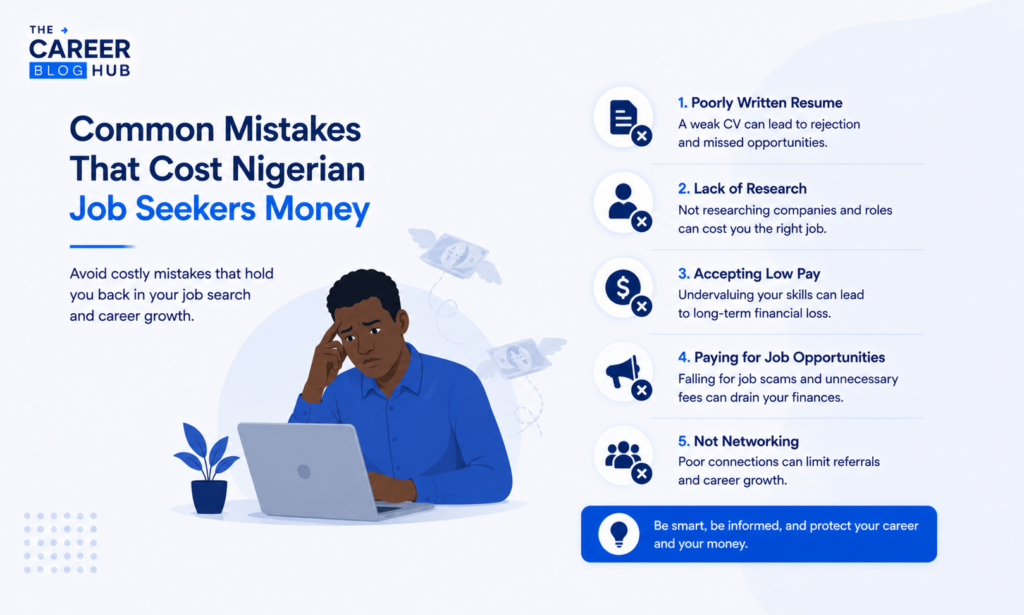
The most expensive mistake is naming a number that is far below your market value because you are afraid of losing the offer. Employers budget for roles based on market rates, not based on what candidates accept. If you ask for significantly less than the budgeted range, you are leaving money on the table that the company was already prepared to pay.
The second costly mistake is refusing to give any number at all. Saying “I am flexible” or “I will accept whatever you offer” does not make you appear agreeable. It makes you appear uninformed about your own market value, which weakens your negotiating position at every subsequent stage of the process.
The third mistake is failing to consider the full package. A base salary of N400,000 with strong health coverage, a housing allowance, and an annual bonus can be worth significantly more than N500,000 with no benefits at all. Always evaluate and negotiate the complete package, not just the headline number.
How to Negotiate After an Offer Is Made
If the initial offer comes in below your range, you have more room than most people think. A professional and gracious counter-offer rarely kills deals. What kills deals is being aggressive, making ultimatums, or expressing disappointment in a way that makes the employer feel criticized.
A strong counter sounds like this: “Thank you for the offer. I am genuinely excited about this role and the team. The salary is slightly below what I had in mind given my background and the market research I have done. Would you be open to discussing moving to X? I am confident that my contribution would justify that level quickly.”
This approach is respectful, specific, and gives the employer a clear path to closing the deal at a better number for you. Most reasonable employers expect and respect professional counter-offers.
For customer service professionals who are applying this negotiation framework to specific job searches in Lagos, our Customer Service Jobs in Lagos page has current verified vacancies where strong salary negotiation from day one significantly impacts long-term earnings in this sector.
Make Your CV Stand Out
If your CV isn’t clearly showcasing your technical projects, academic achievements, SIWES readiness, leadership experience, and engineering or technology skills, you may be missing opportunities. A professionally structured CV can help present your value more effectively. Need yours refined? Contact us via WhatsApp: +2348145289661.
FAQs: Desired Compensation Question
What should I say if I have no idea what the market rate is for the role?
Start with online research before any interview. Check salary data on Glassdoor, Jobberman, and LinkedIn Salary for similar roles in your industry and city. Talk to professional contacts who do similar work. Look at job postings that include salary ranges. Even thirty minutes of research gives you enough information to provide a credible range rather than a guess.
Should I include my current salary in my answer?
You are not obligated to disclose your current salary in Nigeria or most other countries. If asked, you can say “I would prefer to focus on the value I bring to this role and what the market suggests for this level rather than anchoring on my current package.” This is professional, widely accepted, and protects your negotiating position regardless of where you currently sit in the market.
What if the company says the budget is fixed and non-negotiable?
Even when a company says the base salary is fixed, other elements of the package often are not. Negotiate on signing bonuses, additional leave days, professional development budgets, remote work flexibility, or earlier performance reviews that could unlock a salary increase sooner than the standard cycle. Almost every offer has some flexibility somewhere even when the headline number appears firm.
Conclusion: Name Your Number and Own It
The desired compensation question is not a trap. It is an opportunity to demonstrate market awareness, professional confidence, and the kind of self-knowledge that employers associate with high-performing candidates. The framework in this post, the research process, the three-component answer structure, and the sample responses give you everything you need to walk into your next salary conversation prepared.
How to answer salary expectations without underselling yourself is a question that every working professional faces repeatedly throughout their career. The more comfortable you become with this conversation, the more of your actual market value you will capture across every role you take.
Pair your confident salary negotiation skills with an equally polished professional presence by reading our guide on How to Put Your LinkedIn on Your Resume which ensures every part of your professional package works together to communicate the value you deserve to be paid for.
For the latest verified job opportunities across Nigeria where your new negotiation skills can be put to immediate use, explore our recent article on Jobs in Kaduna and visit thecareerbloghub for more career resources and job listings updated regularly across every industry and city in Nigeria.