
You open your resume, stare at the skills section, and freeze. You know you have skills. You use them every day at work or in school. But when it comes to writing them down in a way that impresses a hiring manager or passes an ATS filter, the words just do not come. You end up listing generic phrases like “good communication” and “team player” that every other candidate is also writing, and wonder why your resume keeps getting ignored.
This post fixes that problem completely. We have put together a comprehensive list of skills to put on a resume across every major industry and career level, explained the difference between hard and soft skills, and shown you exactly how to present them in a way that gets your resume noticed both by automated screening systems and by the humans reading it afterward.
Why the Skills Section of Your Resume Is More Important and What You Need to do
Most job seekers treat their resume skills section as an afterthought. They fill in a few generic phrases at the bottom after spending most of their energy on work history and education. That approach is costing them interviews they are qualified for.
The reason is simple. Most companies now use Applicant Tracking Systems to screen resumes before a human reviews them. According to Jobscan, over 98 percent of Fortune 500 companies use ATS software that scans for specific keywords before any person sees your application. If your resume skills section does not contain the exact terms the system is looking for, your resume gets filtered out automatically regardless of how strong your experience is.
Beyond ATS screening, hiring managers use the skills section to quickly validate that you have the core competencies the role requires. A well-organized skills section in a resume tells the recruiter in under ten seconds whether you are worth spending more time on. Getting it right is not optional. It is the foundation of a competitive application.
For more career resources that help Nigerian professionals build stronger applications and find better opportunities, visit thecareerbloghub where we publish practical career guidance every week.
Make Your CV Stand Out
If your CV isn’t clearly showcasing your technical projects, academic achievements, SIWES readiness, leadership experience, and engineering or technology skills, you may be missing opportunities. A professionally structured CV can help present your value more effectively. Need yours refined? Contact us via WhatsApp: +2348145289661.
The Two Types of Resume Skills You Need to Know
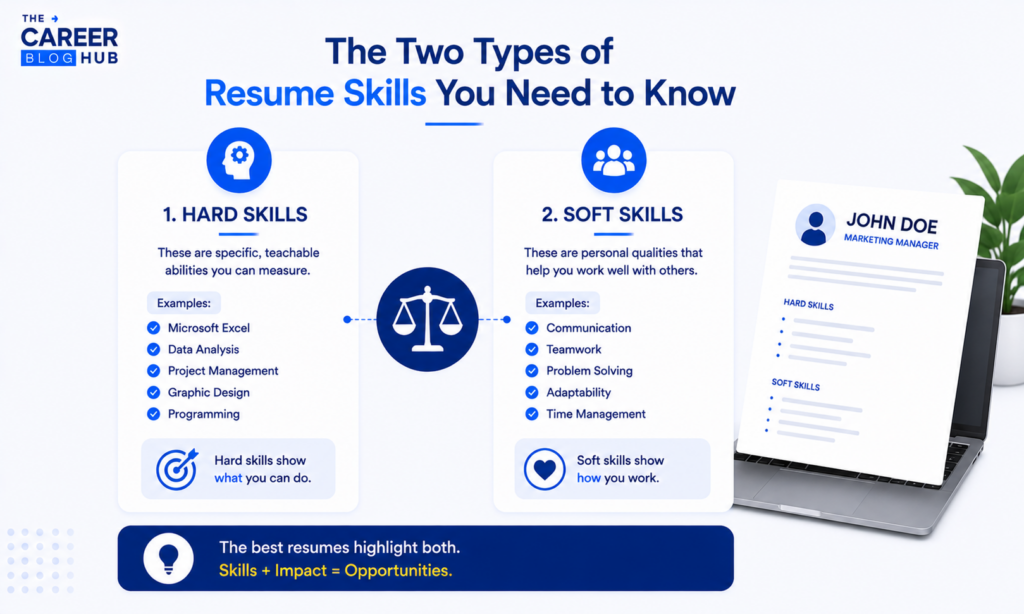
Before we get to the full list, it is important to understand the fundamental distinction between the two categories of skills for CV that employers evaluate.
Hard skills are technical, teachable, and measurable. They are the specific capabilities you have learned through education, training, or experience that allow you to perform the core tasks of a job. Examples include proficiency in Microsoft Excel, the ability to write SQL queries, knowledge of IFRS accounting standards, or holding a NEBOSH safety certification.
Soft skills are interpersonal and behavioral. They describe how you work, how you communicate, how you handle pressure, and how you collaborate with others. Examples include leadership, problem-solving, adaptability, and attention to detail. They are harder to measure but equally valued, particularly for roles involving teams, clients, or management responsibility.
The most competitive resumes include a strategic mix of both. Hard skills prove you can do the job. Soft skills demonstrate how you will fit into the team and the culture.
Complete List of Skills to Put on a Resume by Category
Hard Skills for Resume: Technical Abilities
Computer and Technology Skills
Technology skills are among the most universally valued hard skills for resumes across every industry in Nigeria and globally. The specific tools you list should match the role you are applying for, but the following represent the most consistently requested across job descriptions.
For general office and administrative roles, essential skills include Microsoft Office Suite at an advanced level particularly Excel with pivot tables, VLOOKUP, and Power Query, Google Workspace including Docs, Sheets, and Slides, and proficiency in project management tools like Asana, Trello, or Microsoft Project.
For technology and data roles, the most in-demand skills include SQL for database querying, Python or R for data analysis, Power BI or Tableau for data visualization, cloud platforms including AWS, Google Cloud, and Microsoft Azure, JavaScript and React for web development, and cybersecurity fundamentals including network security and vulnerability assessment.
For digital marketing roles, key technical skills include Google Analytics and Google Ads, Meta Ads Manager, SEO tools like Ahrefs or SEMrush, email marketing platforms like Mailchimp or HubSpot, and social media management tools like Hootsuite or Sprout Social.
Financial and Accounting Skills
Finance is one of the most skills-specific fields in Nigeria’s job market. The professional skills for resume that consistently appear in banking and finance job descriptions include financial modeling and valuation, IFRS financial reporting, budget preparation and variance analysis, tax computation under Nigerian tax law, internal audit and risk assessment, credit analysis and loan structuring, SAP ERP and QuickBooks proficiency, and treasury management.
If you hold ICAN, ACCA, or CFA qualifications, list them prominently in both your skills section and your certifications section. These credentials significantly elevate your credibility compared to candidates with equivalent experience but no professional qualification.
Healthcare and Clinical Skills
For nurses, doctors, pharmacists, and public health professionals, key skills for resume that employers specifically look for include Basic Life Support and ACLS certification, medication administration and dosage calculation, patient assessment and triage, clinical documentation and electronic health records, DHIS2 for health data management, and specific therapeutic area knowledge such as maternal health, pediatrics, or infectious disease management.
For our Nigerian readers in the nursing profession who are also looking for verified hospital vacancies alongside building their skills profile, our recent article on Nursing Jobs in Nigeria covers current verified hospital vacancies from top employers across the country.
Legal and Compliance Skills
For lawyers and compliance professionals, the best skills for a resume include contract drafting and negotiation, due diligence methodology, regulatory compliance advisory, corporate secretarial practice under CAMA 2020, litigation case management, FIRS tax dispute resolution, and Anti-Money Laundering and Know Your Customer compliance frameworks.
Engineering and Technical Skills
For engineering professionals across civil, mechanical, electrical, and petroleum disciplines, the skills that consistently appear in Nigerian and international job descriptions include AutoCAD and Civil 3D for civil engineers, STAAD Pro and ETABS for structural engineers, COREN registration for Nigerian engineers, NEBOSH certification for HSE roles, Petrel and Prosper for petroleum engineers, and PMP or PRINCE2 for project management roles.
Supply Chain and Operations Skills
Supply chain is one of the fastest-growing fields for specialized skills in Nigeria. The most in-demand resume skills for this sector include SAP Materials Management, demand planning and inventory optimization, vendor management and contract negotiation, Incoterms knowledge for import and export roles, warehouse management systems, and CIPS professional membership for procurement specialists.
Soft Skills for Resume: Interpersonal Abilities
Communication Skills
Strong communication is the most universally requested soft skill for resumes across every industry. But listing “communication skills” as a bare phrase tells the employer nothing specific. The more effective approach is to specify the type of communication you excel at. Examples include executive-level presentation and stakeholder communication, technical report writing, cross-cultural communication for international roles, client relationship communication for sales and banking, and persuasive proposal writing for NGO and grant roles.
For professionals preparing complete application packages alongside their skills section, our guide on Examples of Professional Summary in Resume gives you 50 ready-to-use templates that pair perfectly with a strong skills section across every industry.
Leadership and Management Skills
Leadership soft skills are particularly important for mid-career and senior professionals. Rather than simply listing “leadership,” specify the context and scale of your leadership. Examples include team leadership for groups of specific sizes, performance management and coaching, cross-functional project leadership, crisis management and decision-making under pressure, and staff development and succession planning.
Analytical and Problem-Solving Skills
Employers across every sector in Nigeria consistently rank analytical thinking among the top good skills to put on a resume for professional roles. The strongest way to present analytical skills is to pair them with a brief example in your work history that demonstrates the skill producing a measurable positive outcome. In the skills section itself, you might list data-driven decision-making, root cause analysis, business case development, or quantitative research methodology.
Adaptability and Learning Agility
In a rapidly evolving professional environment, the ability to learn new tools quickly, adjust to changing priorities, and perform effectively under uncertainty is increasingly valued. This is especially relevant for professionals in technology, NGO work, and financial services where regulatory and operational landscapes shift frequently.
Emotional Intelligence and Interpersonal Skills
Emotional intelligence encompasses empathy, self-awareness, social awareness, and relationship management. For roles that involve managing people, serving clients, or navigating complex organizational dynamics, listing specific interpersonal competencies such as conflict resolution, negotiation, team motivation, or cultural sensitivity makes your soft skills section meaningfully more specific and credible.
Skills to Put on a Resume by Industry
Understanding which skills matter most in specific industries helps you build a targeted skills section that resonates with the right employers.
- For banking and financial services, the most valued combination is financial modeling with IFRS knowledge plus relationship management and credit analysis proficiency, underpinned by strong regulatory knowledge of CBN guidelines.
- For the NGO and development sector, the most requested skills are M and E framework design with DHIS2 and KoBoCollect proficiency, proposal writing for USAID or Global Fund programmes, gender mainstreaming, and community mobilization experience. For Nigerian professionals exploring current NGO openings where these skills are actively required, our Work From Home Jobs page covers remote development sector roles alongside field-based positions.
- For technology and fintech, employers prioritize cloud certifications, programming language proficiency in Python or JavaScript, agile development methodology, and API integration experience alongside the soft skills of autonomous working and asynchronous communication.
- For marketing and communications, the highest-value skills include SEO and performance marketing, data analytics for campaign optimization, social media platform expertise, and copywriting with demonstrated conversion results. For writers and content professionals building their resume skills around copywriting, our Copywriting Jobs page shows exactly what skills leading employers are requiring from copywriters right now.
How to Write a Resume Skills Section That Passes ATS
An ATS-friendly skills for resume section uses the exact keywords that appear in the job description. Here is a simple three-step process to get it right every time.
First, read the job description carefully and highlight every skill, qualification, or competency mentioned twice or more. These are the employer’s priority requirements. Second, identify which of those skills you genuinely possess and can speak to in an interview. Third, write those skills in your skills section using the exact phrasing from the job description, not synonyms or abbreviations that the ATS might not recognize.
Do not pad your skills section with abilities you cannot genuinely demonstrate. Listing machine learning skills you cannot discuss technically, or fluency in a language you can barely read, creates a credibility problem the moment you are tested or interviewed. Honesty combined with strategic keyword use is always the right approach.
Common Resume Skills Mistakes to Avoid
1. The most common mistake is listing skills that are too generic to be useful. “Good communication” and “team player” have appeared on so many resumes that they have lost all meaningful signal for recruiters. Replace them with specific, demonstrable, and contextually appropriate skills that reflect your actual professional capabilities.
2. The second mistake is listing too many skills without prioritization. A skills section with thirty items of equal visual weight is harder to read than one with eight to twelve well-chosen and clearly organized skills. Quality and relevance matter more than volume.
3. The third mistake is never updating your skills section between applications. Your skills section should be reviewed and adjusted for every role you apply for, with the most relevant skills for that specific job listed first and most prominently.
For professionals who want to understand how their salary expectations should align with the skills they are listing, our article on Desired Compensation Answer gives you the framework to negotiate the pay your skills genuinely deserve.
Make Your CV Stand Out
If your CV isn’t clearly showcasing your technical projects, academic achievements, SIWES readiness, leadership experience, and engineering or technology skills, you may be missing opportunities. A professionally structured CV can help present your value more effectively. Need yours refined? Contact us via WhatsApp: +2348145289661.
FAQs: Skills to Put on a Resume
How many skills should I list on my resume?
Between eight and fifteen skills is the sweet spot for most resumes. Fewer than eight can make you look underprepared. More than fifteen starts to dilute the impact of your strongest capabilities. Focus on quality and relevance rather than trying to list everything you have ever learned. Every skill on your resume should earn its place by being directly relevant to the role you are applying for.
What if I am a fresh graduate with limited work experience?
Fresh graduates should focus their skills section on academic and project-based skills that are relevant to their target role. Include any software tools you learned in university, research methodologies from your thesis, leadership roles in student organizations, language abilities, and any certifications you have earned. If you are targeting roles that require specific technical skills you have not yet developed, start building them through free online platforms before your next application.
How do I know which skills are most valued in my field?
Read ten to fifteen job descriptions for roles similar to what you are targeting and note which skills appear most frequently. Those are your priority skills. Cross-reference this with your genuine capabilities and focus your skills section on the intersection of what employers want most and what you can genuinely deliver.
Conclusion: Build a Skills Section That Gets You Hired
The skills to put on a resume covered in this post span technology, finance, healthcare, legal, engineering, supply chain, marketing, and NGO sectors across both hard and soft skill categories. Every skill on this list is genuinely valued by Nigerian and international employers right now in 2025.
Use the industry lists, apply the ATS framework, and tailor your skills section for every role you apply for. A targeted, specific, and honest skills section combined with a strong professional summary is the foundation of a resume that consistently generates interviews.
Good skills to put on a resume for fresh graduates in Nigeria 2025 and professional skills for a resume in banking and finance are search terms that lead to this post because these are the questions real job seekers are asking. The answers are here. Now build the skills section that gets you hired.
For professionals who want to align their complete resume package with a strong LinkedIn profile, our guide on How to Put Your LinkedIn on Your Resume walks you through the exact steps to ensure your online presence reinforces every skill you list on your resume.
Keep visiting thecareerbloghub for more practical career guides, job listings, and application resources that help Nigerian professionals present themselves at their very best and land the opportunities that match their skills and career ambitions.