
Writing the job duties of a medical assistant on a resume sounds simple until you are actually sitting in front of a blank document describing the work you know how to do, but cannot seem to put into words that sound professional and compelling. Most medical assistant resumes fail not because the candidate lacks experience but because they describe their duties in ways that are either too vague to mean anything or too generic to stand out from the hundreds of other resumes a clinic receives for the same position.
This post gives you the fix. We have written copy-and-paste medical assistant resume duties examples for both entry-level candidates and experienced professionals, organized by clinical function and administrative category, so you can build a resume that accurately represents your work and genuinely impresses the hiring managers who read it.
Why How You Describe Your Duties Matters as Much as the Duties Themselves
Two medical assistants can perform identical tasks in identical clinical settings and produce resumes that create completely different impressions. The difference is not what they did. It is how they described it.
A hiring manager reading “assisted with patient care” learns almost nothing useful. A hiring manager reading “performed comprehensive patient intake assessments including vital signs measurement, medication reconciliation, allergy verification, and chief complaint documentation for an average of 28 patients per shift” immediately understands the scope, volume, and clinical precision of your work. The second description passes ATS keyword screening more effectively, creates a more memorable impression, and gives the interviewer specific conversation points to explore.
According to the American Association of Medical Assistants, medical assistants perform a broad dual function spanning clinical and administrative duties, making the role one of the most versatile in ambulatory care settings. Your resume needs to reflect that breadth with the specificity that makes your particular contribution credible and distinctive.
For more career resources and practical job search guidance, visit thecareerbloghub where we publish career guides and verified job listings every week.
Make Your CV Stand Out
If your CV isn’t clearly showcasing your technical projects, academic achievements, SIWES readiness, leadership experience, and engineering or technology skills, you may be missing opportunities. A professionally structured CV can help present your value more effectively. Need yours refined? Contact us via WhatsApp: +2348145289661.
Medical Assistant Resume Duties: Entry-Level Examples
Entry-level medical assistant resume duties should focus on clinical training, externship experience, and any relevant practical competencies, even if your experience came from supervised training rather than independent employment.
Clinical Duties for Entry-Level Medical Assistants
Patient Assessment and Intake
The strongest entry-level descriptions reference your training environment, the patient volume you worked with, and the specific procedures you performed under supervision.
- Performed patient intake assessments for 20 to 30 patients daily during a 160-hour externship at a family medicine clinic, including blood pressure measurement, temperature recording, pulse and respiratory rate assessment, oxygen saturation monitoring, and chief complaint documentation
- Completed patient health history reviews and medication reconciliation under physician supervision, accurately updating electronic health records using the clinic’s EMR system with zero documentation errors across the externship period
- Verified patient identification and allergy status before each clinical encounter in accordance with the clinic’s safety protocols, flagging discrepancies to the supervising nurse immediately
Specimen Collection and Laboratory Support
- Performed venipuncture blood draws under supervision on 40 patients across the externship period with a documented first-attempt success rate of 82 percent, consistently improving through coached practice with senior phlebotomy staff
- Collected mid-stream urine specimens, nasal swabs, and wound swabs following aseptic technique protocols and processed specimens for same-day delivery to the clinic’s external laboratory partner
- Conducted point-of-care glucometry testing and urinalysis using clinic equipment, recorded results accurately in the EMR, and alerted the supervising nurse to critical values immediately
Medication Administration
- Prepared intramuscular injection sites and administered vaccines under physician authorization following the clinic’s immunization schedule protocols, observing patients for adverse reactions during the required post-vaccination monitoring period
- Prepared oral medication doses for dispensing by licensed clinical staff, verifying drug name, dose, route, and patient identification against prescriptions at each step of the preparation process
Administrative Duties for Entry-Level Candidates
Administrative competency is equally important for medical assistant positions and should be represented clearly on your resume even at entry level.
- Managed appointment scheduling for a four-provider outpatient clinic using Practice Fusion software, maintaining an average daily scheduling efficiency rate of 96 percent across the externship period
- Verified patient insurance eligibility at check-in for 15 to 20 patients daily, identifying coverage discrepancies and resolving them with the billing coordinator before the patient was roomed
- Maintained accurate and HIPAA-compliant patient health records in the clinic’s EHR system, completing documentation within 10 minutes of each patient encounter to ensure physician access to current clinical information
For entry-level candidates who also want to explore verified job listings to apply their polished resume to right now, our Jobs in Nigeria Today page has current openings across healthcare and other sectors updated regularly.
Medical Assistant Resume Duties: Experienced Candidate Examples
Experienced medical assistant responsibilities for resume descriptions should emphasize volume, outcomes, specialization, and any supervisory or quality improvement contributions you have made.
Advanced Clinical Duties for Experienced Medical Assistants
Patient Assessment and Clinical Coordination
- Conducted comprehensive patient intake assessments for 35 to 45 patients daily in a high-volume internal medicine practice serving a diverse adult patient population, including full vital signs measurement, medication reconciliation, allergy documentation, and chief complaint recording with consistent accuracy across a three-year tenure
- Served as the primary clinical liaison between patients and the physician team, communicating patient concerns and clinical changes clearly and prioritizing urgent matters for immediate physician attention throughout the clinical day
- Managed the post-visit patient education process for all consultations in an assigned examination suite, providing clear medication instructions, follow-up scheduling guidance, and disease management education tailored to each patient’s health literacy level
Phlebotomy and Laboratory Coordination
- Performed high-volume phlebotomy in a dedicated clinic phlebotomy station processing 50 to 70 specimens daily, maintaining a documented first-attempt venipuncture success rate of 96 percent across two years of practice
- Coordinated specimen transport and external laboratory relationships, ensuring same-day delivery of time-sensitive specimens and following up on outstanding results to facilitate timely clinical decision-making for the physician team
- Conducted in-office laboratory testing including electrocardiography, spirometry, glucometry, urinalysis, rapid strep, influenza, and pregnancy testing, interpreting result artifacts for quality before transmission to the physician
Procedure Assistance and Medication Administration
- Assisted physicians during in-office minor surgical procedures including wound debridement, laceration repair, incision and drainage, skin biopsy, and joint aspiration by providing sterile field management, instrument handling, and specimen preparation
- Administered intramuscular, subcutaneous, and intradermal injections including influenza and pneumococcal vaccines, allergy immunotherapy, vitamin B12 injections, and Depo-Provera under physician authorization, with accurate dose preparation and patient identification verification at every administration
- Managed the clinic’s controlled substance cabinet including accurate daily log maintenance, inventory reconciliation, and coordination with the clinic pharmacist for restocking, with zero discrepancies across quarterly audits
Quality and Compliance Contributions
This category is where experienced medical assistants can most meaningfully differentiate themselves from candidates with equivalent years of service.
- Led the implementation of a standardized patient intake workflow that reduced average rooming time from 12 minutes to 7 minutes, improving physician schedule efficiency by 22 percent and increasing daily patient volume capacity by four appointments
- Trained three newly hired medical assistants in clinical protocols, EMR documentation standards, and patient communication expectations during their first 90 days, with all three achieving full clinical competency within the onboarding period
- Coordinated the clinic’s annual infection control audit including surface sampling, sterilization log review, and sharps disposal compliance verification, achieving a zero-deficiency audit outcome for two consecutive years
Administrative Duties for Experienced Medical Assistants
Administrative competency at the experienced level should reflect increased scope, accuracy metrics, and process improvement contributions.
- Managed prior authorization requests for specialist referrals, diagnostic imaging, and specialty medications for a four-provider practice, reducing authorization turnaround time by 35 percent through proactive insurer follow-up and optimized documentation submission
- Processed insurance eligibility verification and benefits checks for 40 to 60 patients daily across six insurance carriers, achieving a 98 percent clean-claim submission rate through accurate upfront verification and billing code review
- Served as the clinic’s designated EHR super-user following a software transition, training 12 clinical and administrative staff members on new workflows and providing ongoing technical support that reduced documentation errors by 40 percent in the post-transition period
- Coordinated physician scheduling across two clinic locations using a centralized scheduling platform, managing 350 to 400 patient appointments weekly and maintaining an average no-show rate of 8 percent through proactive patient reminder protocols
For experienced medical assistant candidates who also want to understand how to handle the salary conversation when they receive an interview offer, our article on Desired Compensation Answer gives you the framework to negotiate your compensation without underselling your clinical expertise.
Medical Assistant Resume Skills Section: What to Include
Alongside your duty descriptions, a strong medical assistant resume skills section signals your technical competency to both ATS systems and human reviewers. Here is what belongs in a well-constructed skills section.
Clinical skills worth listing explicitly include vital signs assessment, phlebotomy and venipuncture, electrocardiography, spirometry, medication administration across injection routes, wound care and dressing changes, sterile field preparation, point-of-care testing, urinalysis, glucometry, and specimen collection and handling.
Administrative and technology skills that employers specifically search for include proficiency in named EHR systems such as Epic, Athenahealth, eClinicalWorks, or Practice Fusion, ICD-10 and CPT medical coding, insurance eligibility verification and prior authorization, HIPAA compliance and patient confidentiality protocols, appointment scheduling and patient communication management, and medical terminology.
Certification credentials including CMA from the AAMA, RMA from the AMT, NCMA from the NCCT, BLS certification, and any specialty certifications should be listed prominently in both your skills section and a dedicated certifications section.
For candidates who want to see how industry-standard medical assistant job titles should appear on their resume alongside their duty descriptions, our article on Work Position Title covers how to choose the right professional title that maximizes your ATS visibility and recruiter recognition.
How to Quantify Your Medical Assistant Duties
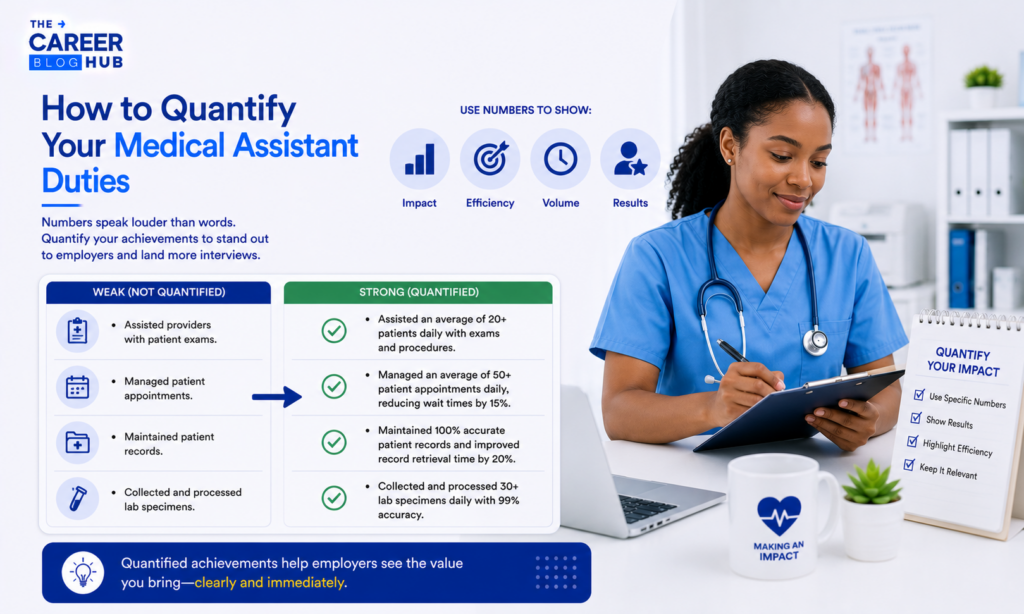
The single most effective upgrade you can make to any medical assistant job description for a resume is adding specific numbers and metrics that demonstrate the scale and quality of your work.
- Patient volume numbers are the most universally applicable. How many patients did you see per day, per week, or per shift? How many specimens did you collect? How many injections did you administer? These numbers transform abstract duty claims into concrete professional evidence.
- Quality metrics are the next most powerful addition. What was your venipuncture first-attempt success rate? What was your patient satisfaction rating? What was your documentation accuracy rate? What was the clinic’s clean-claim submission percentage while you managed the verification process? Any metric that demonstrates accuracy, efficiency, or quality is worth including.
- Improvement contributions give senior candidates the strongest differentiation. If you implemented a workflow change that reduced wait times, trained new staff that reached competency faster, or identified a quality issue that improved patient safety, quantifying those contributions separates you from candidates who have similar clinical experience but no demonstrated initiative or impact beyond the basic job requirements.
For healthcare professionals who want to complement strong resume duty descriptions with equally strong interpersonal skills presentation, our article on Interpersonal Skills to Put on Your Resume gives you specific, ready-to-use examples of communication and empathy skills that healthcare employers specifically value in clinical support staff.
Common Medical Assistant Resume Duty Mistakes to Avoid
1. The most damaging mistake is passive voice. “Was responsible for patient intake” is weaker than “Performed patient intake.” “Assisted with medication administration” is weaker than “Administered medications under physician authorization.” Every duty description should begin with a strong active verb that accurately describes what you did, not what you were expected to do.
2. The second mistake is using identical language to describe different roles. If you have worked at three different clinics, each role’s description should reflect the specific patient population, procedure mix, and administrative systems of that environment. Generic descriptions that could apply to any clinic suggest you have not thought carefully about what made each experience distinct and valuable.
3. The third mistake is omitting administrative duties entirely. Many medical assistant candidates focus exclusively on clinical duties and neglect the administrative half of the role that employers value equally. If you managed scheduling, processed authorizations, verified insurance, or coordinated referrals, these duties belong on your resume with the same specificity you apply to your clinical descriptions.
Make Your CV Stand Out
If your CV isn’t clearly showcasing your technical projects, academic achievements, SIWES readiness, leadership experience, and engineering or technology skills, you may be missing opportunities. A professionally structured CV can help present your value more effectively. Need yours refined? Contact us via WhatsApp: +2348145289661.
FAQs: Job Duties of a Medical Assistant on a Resume
How many bullet points should I use for each medical assistant position?
Four to six bullet points per position is the standard for experienced candidates. For entry-level candidates describing an externship or training placement, three to five bullet points is appropriate. Fewer than three suggests you have not thought deeply about your contribution. More than six starts to read like a comprehensive job description rather than a targeted resume highlighting your most significant clinical and administrative competencies.
How do I write medical assistant duties when my official title was different?
Use the industry-standard functional title that accurately describes your responsibilities alongside or instead of your official company title where appropriate. If your official title was “Clinical Support Coordinator” but your duties were identical to a medical assistant role, you can list Medical Assistant as your functional title and note your official title parenthetically. What matters is that the duties you describe are accurate and the title you use is the one that recruiters and ATS systems are searching for.
What is the most important duty to feature prominently on a medical assistant resume?
Lead with the duty that most directly matches the most critical requirement in the specific job description you are responding to. If the posting emphasizes phlebotomy, lead with your phlebotomy experience. If it emphasizes EHR management, lead with your documentation and EMR proficiency. The most important duty is always the one the employer cares most about for their specific clinical environment, not the duty you personally find most interesting.
Conclusion: Build Your Medical Assistant Resume and Get More Interviews
The job duties of a medical assistant on a resume example in this post cover patient assessment, phlebotomy, medication administration, procedure assistance, quality improvement contributions, and administrative functions for both entry-level and experienced candidates. Every example follows the same principle: use a strong active verb, describe the specific clinical context, and quantify the outcome where possible.
Take the examples closest to your own clinical experience, adapt the specific details to reflect your actual patient volume, procedures, and workplace, and build a resume that demonstrates genuine clinical competence rather than simply asserting it.
Medical assistant resume bullet points for experienced candidates and entry-level medical assistant job description for resume with no experience are exactly the searches that bring professionals to this post because these questions determine whether your application gets an interview or gets ignored. The answers are here.
For healthcare professionals who also want to explore digital marketing and communications roles that exist in growing health information and patient education organizations, our Digital Marketing Jobs page covers current openings where healthcare background and communications skills intersect.
For graduate trainees and early career professionals building complete application packages across multiple sectors, our comprehensive guide on Top 30 Graduate Trainee Roles covers the best structured entry-level programmes at Nigeria’s top employers across every industry, including healthcare.
Keep visiting thecareerbloghub for more practical career guides, resume writing resources, and verified job listings that help professionals at every level present their best professional self and land the opportunities they deserve.