
You have applied to dozens of jobs and heard almost nothing back. Your experience looks solid, your qualifications are genuine, but something is not clicking. More often than not, the problem is not what you have done. It is how you are presenting what you can do. Specifically, the skills section of your resume is either too vague, too long, or missing the exact words that hiring managers and applicant tracking systems are scanning for.
The good news is that fixing your resume skills section is one of the fastest ways to dramatically improve your application results. This post gives you the complete guide to good skills to put on a resume, with real resume skills examples across different industries and experience levels, so you can build a skills section that actually works.
Why Your Resume Skills Section Matters More Than You Think
Most job seekers treat the skills section of their resume as an afterthought. They list a few generic phrases at the bottom and move on. That is a costly mistake. According to research by Jobscan , over 98 percent of Fortune 500 companies use applicant tracking systems that scan resumes for specific keywords before a human ever sees them. If your skills section does not include the right keywords, your resume gets filtered out automatically regardless of how strong your actual experience is.
Beyond ATS screening, hiring managers use the skills section to quickly validate that you have the core competencies needed for the role. A well-constructed resume skills list signals professional awareness and saves the recruiter time by confirming at a glance that you are worth interviewing.
The skills section is not where you list everything you have ever learned. It is where you strategically present the most relevant capabilities that match what the employer is specifically looking for right now.
For more career resources including job listings and application tips that help Nigerian professionals land opportunities faster, visit thecareerbloghub where we publish practical career guidance every week.
Make Your CV Stand Out
If your CV isn’t clearly showcasing your technical projects, academic achievements, SIWES readiness, leadership experience, and engineering or technology skills, you may be missing opportunities. A professionally structured CV can help present your value more effectively. Need yours refined? Contact us via WhatsApp: +2348145289661.
The Two Types of Skills Every Resume Needs
Before diving into examples, it is important to understand the fundamental distinction between the two categories of skills for resumes that employers evaluate.
1.Hard skills
Hard skills are technical, teachable abilities that can be measured and verified. Examples include proficiency in Microsoft Excel, the ability to write SQL queries, knowledge of accounting standards like IFRS, or a certification in project management. Hard skills are learned through education, training, and practice and they signal that you can actually do the job’s core tasks.
2. Soft skills
Soft skills are interpersonal and behavioral qualities that determine how you work, communicate, and collaborate with others. Examples include leadership, problem-solving, time management, and communication. Soft skills are harder to measure but equally valued by employers, particularly for roles that require teamwork, client interaction, or management responsibility.
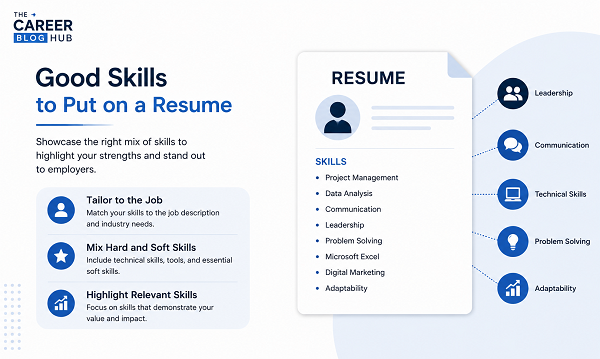
The most competitive resumes include a strategic combination of both. Leading with your strongest hard skills shows technical credibility, while weaving in relevant soft skills shows cultural fit and professional maturity.
Good Skills to Put on a Resume: Examples by Category
Hard Skills for Resume: Technical Abilities Employers Want
1.Data and Analytics Skills
Data literacy has become one of the most in-demand skill sets across virtually every industry in Nigeria and globally. Whether you work in banking, marketing, public health, or supply chain, the ability to collect, analyze, and interpret data is increasingly expected at every professional level.
Strong hard skills for resume in this category include Microsoft Excel at an advanced level including pivot tables, VLOOKUP, and Power Query, SQL for database querying and data extraction, Power BI or Tableau for data visualization, Python or R for statistical analysis, and DHIS2 for health sector data management. If you hold any data certification such as Google Data Analytics Professional Certificate or Microsoft Power BI Data Analyst Associate, list it prominently in both your skills section and your certifications section.
2. Financial and Accounting Skills
For finance professionals, the skills that consistently appear in Nigerian employer job descriptions include financial statement analysis, IFRS reporting, budget preparation and management, tax computation and compliance, internal audit methodology, SAP ERP proficiency, and QuickBooks or Sage accounting software. ICAN or ACCA membership should be listed prominently as it significantly elevates your credibility in this space.
3. Technology and Digital Skills
Technology skills are among the fastest-growing in-demand resume skills across every sector. Relevant examples depending on your role include HTML and CSS for web roles, Python and JavaScript for software development, Google Analytics and Meta Ads Manager for digital marketing, Salesforce CRM for sales and customer success roles, and cloud platforms such as AWS, Google Cloud, or Microsoft Azure for technical and data roles.
4. Project Management Skills
Project management capability is valued across industries from construction to NGO programming to technology product development. Listing proficiency in tools such as Microsoft Project, Asana, Jira, or Trello alongside a PMP or PRINCE2 certification signals that you can manage complex work systematically and deliver results against deadlines.
For digital marketing professionals building their resumes around the most current skill demands, our Digital Marketing Jobs page shows exactly what skills leading Nigerian employers are requiring from marketing candidates right now.
Soft Skills for Resume: Interpersonal Abilities That Seal the Deal
1.Communication Skills
Strong communication is the single most universally requested soft skill for a resume across every industry and seniority level. But simply listing “communication skills” is too vague to be useful. Instead, be specific about the type of communication you excel at. For example, you might describe yourself as skilled in executive-level presentation, technical report writing, stakeholder engagement, or cross-cultural communication depending on your background.
2. Leadership and Team Management
Leadership does not only apply to senior roles. Even as a junior professional, demonstrating that you have led a project, mentored a junior colleague, or taken initiative on a team task signals leadership potential. For senior professionals, be specific about the size of the teams you have led and the outcomes of your leadership.
3. Problem-Solving and Analytical Thinking
Employers across Nigeria consistently rank problem-solving among the top key skills for the resume they look for regardless of the role. The most effective way to present this skill is to pair it with a specific example in your work history that shows how your analytical thinking produced a measurable positive outcome.
4. Adaptability and Learning Agility
In a rapidly changing work environment, the ability to adapt quickly and continuously learn new skills is increasingly valued. This is particularly relevant for professionals entering the tech, fintech, and NGO sectors where tools, regulations, and programme approaches change frequently.
5. Time Management and Organization
The ability to prioritize competing demands, meet deadlines consistently, and manage complex workloads without constant supervision is a critical professional skill for resume that managers look for at every level. If you have managed multiple projects simultaneously or worked in high-pressure environments, make that explicit in your resume narrative.
How to Write a Resume Skills Section That Actually Works
The biggest mistake job seekers make in their resume skills section is listing skills without context or strategy. Here is how to do it correctly.
First, always tailor your skills to the specific job you are applying for. Read the job description carefully and identify the skills mentioned most frequently or most prominently. Those are the skills the employer prioritizes. Mirror that language in your skills section.
Second, organize your skills strategically. Put your most powerful and most relevant skills first. Hiring managers scan from top left to bottom right and the first few skills they read create their initial impression of your technical credibility.
Third, be honest. Only list skills you can confidently demonstrate in an interview or assessment. Listing SQL when you have only done a basic online tutorial will create a credibility problem the moment you are tested. Better to list Excel at an advanced level honestly than to claim Python proficiency you cannot support.
Fourth, avoid listing obvious basics. Microsoft Word and email proficiency are assumed for most professional roles in 2025. Use that space for more differentiating skills that strengthen your competitive position.
For fresh graduates and NYSC corps members working on their first resume, pairing a strong skills section with a compelling professional summary dramatically improves application results. Our guide on Examples of Professional Summary in Resume gives you 50 ready-to-use templates that pair perfectly with a strong skills section.
Industry-Specific Resume Skills Examples
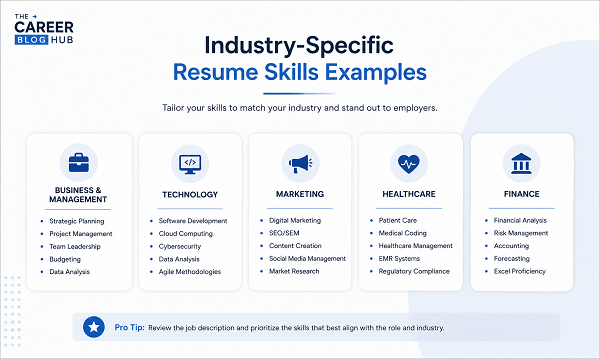
Understanding which skills are most valued in specific industries helps you build a targeted and competitive resume skills list that resonates with the right employers.
- For banking and financial services roles in Nigeria, the most valued skills include credit analysis, financial modeling, KYC and AML compliance, relationship management, loan structuring, CBN regulatory knowledge, and proficiency in Bloomberg or Reuters terminals for treasury roles.
- For oil and gas roles, employers consistently prioritize production engineering software such as Petrel and Prosper, NEBOSH certification for HSE roles, pipeline integrity assessment methodology, NUPRC regulatory knowledge, and strong technical report writing.
- For NGO and development sector roles, the most requested job skills for a resume include M and E framework design, DHIS2 and KoBoCollect proficiency, proposal writing for USAID or Global Fund-funded programmes, community mobilization experience, and gender mainstreaming expertise.
- For technology roles, employers prioritize cloud certifications, programming language proficiency, agile development methodology, API integration experience, and cybersecurity awareness depending on the specific role.
- For legal professionals, key skills include contract drafting and negotiation, regulatory compliance advisory, CAMA 2020 knowledge, due diligence methodology, and court process management for litigation roles.
Top Resume Skills That Are Most In-Demand Right Now
Based on current Nigerian and global job market data, the top resume skills that consistently appear across high-demand job descriptions in 2025 include data analysis and visualization, digital marketing and SEO, project management with recognized certification, programming in Python or JavaScript, cloud computing and cybersecurity, financial modeling and IFRS reporting, proposal writing and donor relations for development professionals, and supply chain analytics.
Adding any two or three of these skills to your professional toolkit and your resume in 2025 significantly improves both your employability and your earning potential across the Nigerian job market.
For professionals who want to see which skills are most valued by Nigeria’s top graduate employers, our comprehensive listing of Top 30 Graduate Trainee Roles shows the exact requirements that leading companies post for entry level positions across banking, oil and gas, FMCG, and technology.
Make Your CV Stand Out
If your CV isn’t clearly showcasing your technical projects, academic achievements, SIWES readiness, leadership experience, and engineering or technology skills, you may be missing opportunities. A professionally structured CV can help present your value more effectively. Need yours refined? Contact us via WhatsApp: +2348145289661.
FAQs: Skills to Put on a Resume
How many skills should I list on my resume?
Most career experts recommend listing between eight and fifteen skills in your resume skills section. Fewer than eight can make you look underprepared. More than fifteen starts to look unfocused and dilutes the impact of your strongest capabilities. Prioritize quality over quantity and make sure every skill listed is genuinely relevant to the role you are applying for.
How do I know which skills to include on my resume?
Read the job description carefully and identify words that appear repeatedly or are listed under required qualifications. Those are your priority skills. Cross-reference them with your genuine capabilities and list the ones that genuinely apply to you. This simple approach ensures your resume is both ATS-friendly and genuinely relevant to what the employer is looking for.
Can I list skills I am still learning?
Yes, with appropriate qualifications. Instead of claiming full proficiency, you can list a skill as currently developing or in progress alongside the certification or course you are completing. For example, listing Google Data Analytics Certificate (in progress) is honest and shows initiative without misrepresenting your current capability level.
Conclusion: Build a Skills Section That Opens Doors
Your resume skills section is one of the most powerful tools you have for getting past ATS filters and capturing a recruiter’s attention in the first ten seconds. The examples and guidance in this post give you everything you need to build a skills section that is specific, strategic, and genuinely competitive in the Nigerian and global job market.
Pair your polished skills section with a strong professional summary and you have a resume that immediately communicates your value to every employer who reads it. For the latest verified job opportunities across Nigeria where your skills can be put to immediate use, explore Jobs in Nigeria Today for current openings across every industry updated regularly.
Keep visiting thecareerbloghub for more practical career resources, resume guides, and job listings that help you find the right opportunity and apply for it in the most competitive way possible.